How to Find the Cheapest Claude API for Your Development Needs
When you start building with large language models, one of the first real pain points is cost. You pick a model that performs well, you wire it into your app, and then the first real bill arrives. That sting is especially sharp with top-tier models like Anthropic's Claude API, which offers excellent reasoning and safety alignment but can get pricey under heavy usage. Developers naturally start hunting for the cheapest Claude API option that doesn't sacrifice reliability or speed.
The good news is that the market has evolved beyond the old take-it-or-leave-it pricing from a single provider. Today you can route requests through an API marketplace that connects you to multiple sellers offering the same models at different rates. This competitive structure changes everything. Instead of being locked into one vendor's pricing tiers, you can let model routing pick the cheapest Claude API endpoint available at that moment, often well below list price.
Why Claude API Costs Vary So Much
Anthropic sets a baseline price for Claude API access, but that's just the starting point. Many resellers and inference providers run their own infrastructure to serve the same models. They buy compute in bulk, optimize their serving stacks, and pass some of those savings along. Some providers focus on high-throughput batch processing, which lowers their inference cost per token. Others compete on latency by using faster hardware or better batching strategies.
The result is a spread of prices across the ecosystem. You might see the same Claude model offered by a half dozen different providers, each with a different per-token rate. Some charge more for guaranteed uptime, others offer steep discounts if you commit to a volume tier. The cheapest Claude API option often comes from a smaller provider that doesn't have the overhead of a giant cloud platform, but still runs reliable infrastructure.
That's where an API marketplace becomes useful. Instead of evaluating each provider manually, you get a single API key that routes your requests to the cheapest available endpoint in real time. The marketplace handles the negotiation, the seller vetting, and the failover logic. You just send your prompt and get back a response, often at a fraction of what you would pay going direct.
What to Watch for When Going Cheap
Price is not the only variable. A cheap endpoint that drops requests or returns garbled output will cost you more in debugging time than you saved on tokens. Here are the main things to check when evaluating a cheap Claude API provider.
Rate Limits and Throughput
Some low-cost providers cap your requests per minute quite low. That's fine for prototyping or low-traffic apps, but if you need to scale, you need to know the ceiling. Ask about rate limits before you build your integration. A provider that looks cheap on paper but cuts you off after a few requests per minute is not actually useful for production.
On the other hand, if your usage is sporadic, a low rate limit might not matter at all. Match the plan to your actual traffic pattern.
Context Window Size
Claude models are known for their large context windows. Some cheaper resellers reduce the maximum context window to lower their memory costs. If your application needs to process long documents or maintain a lengthy conversation history, this can break your workflow. Always confirm the effective context window from the seller, not just the model name.
Similarly, check whether the provider truncates your input or silently drops parts of the context when you exceed their limit. Some do, and you might not notice until you get incomplete results.
Latency and Reliability
A cheap API that takes ten seconds to return a short completion is not a bargain. Latency varies a lot between providers depending on their hardware, load balancing, and network routes. Test with real prompts that match your production traffic. Also check uptime guarantees and historical reliability. Some cheap providers run on spot compute that can disappear with little warning.
An API marketplace often handles this by routing around slow or down endpoints automatically. That redundancy can make a cheap provider more viable than it would be on its own.
Comparing Claude API to Other Models
While we're focusing on finding the cheapest Claude API, it's worth noting how Claude compares to other models in the cost-performance trade-off. OpenAI's GPT-4o is a strong competitor, often priced similarly or slightly higher depending on the provider. Gemini Pro from Google can be cheaper for certain tasks, especially those that benefit from Google's infrastructure integration. Mistral AI offers very competitive pricing for models that are smaller but still capable for many tasks. Llama 3, available through many providers including those on Hugging Face and Together.ai, is open-weight and often the cheapest option per token, but you lose some of the safety tuning and alignment that Claude provides.
The right choice depends on your use case. If you need strong reasoning with a good safety profile, Claude is hard to beat. If you are doing simple classification or extraction, a cheaper model might work just as well. The key is to benchmark your specific task across multiple providers and see which gives the best results for the cost.
How an API Marketplace Changes the Math
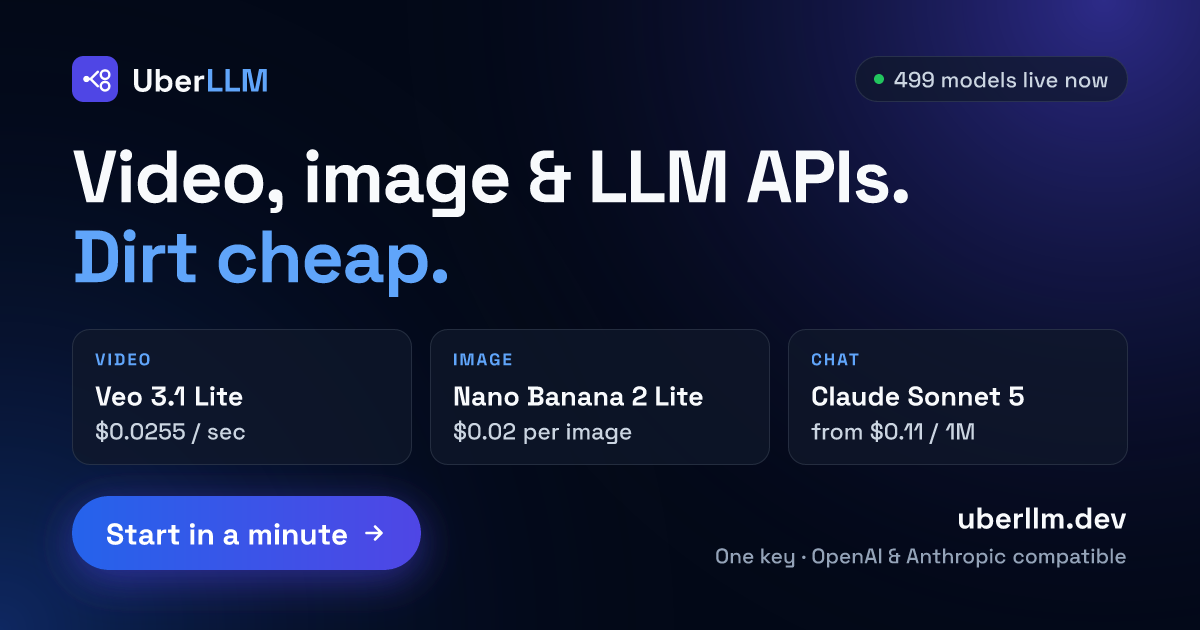
An API marketplace like Uberllm.dev aggregates multiple sellers behind one API key. You send a request, the marketplace routes it to the cheapest available provider that meets your quality and latency requirements. This model routing is dynamic. If one seller raises prices or goes down, the marketplace automatically shifts traffic to another seller. You don't have to update your code or manage multiple keys.
This structure also opens up access to providers you might not find on your own. Smaller inference shops, regional cloud providers, and specialists in batch processing all become reachable through a single integration. The cheapest Claude API for your workload might come from a provider you never heard of, but the marketplace handles vetting and payment so you don't have to worry about reliability.
Another advantage is pricing tiers that adjust in real time. Some marketplaces let sellers bid for your traffic, which can drive prices down even further. For developers, this means you can run more experiments, iterate faster, and keep your monthly costs predictable even as volume grows.
Practical Tips for Lowering Your Token Bill
Beyond choosing the cheapest Claude API provider, you can reduce costs by optimizing how you use the model. Small changes in prompt design and caching strategies can cut your token usage significantly.
- Use shorter prompts. Remove boilerplate instructions that stay the same across requests. Move system prompts into a separate cached context if the provider supports it.
- Limit the output length. Many tasks don't need long completions. Setting a max_tokens value that matches your actual needs saves money on every request.
- Batch requests when possible. Some providers offer discounts for batch processing where latency is less critical. This works well for offline analysis or nightly jobs.
- Monitor your usage. Track token counts per endpoint and per model. You might find that a cheaper model handles a subset of your requests just as well, saving you from using the expensive model for everything.
These optimizations add up quickly, especially at scale. A 10 percent reduction in tokens per request can mean thousands of dollars saved over a year for a busy application.
Wrapping Up
Finding the cheapest Claude API is not about picking one provider and forgetting about it. The market is fluid. Prices change, new sellers appear, and your own usage patterns shift. The smart approach is to build flexibility into your architecture. Use an API marketplace that gives you access to multiple sellers, monitor your costs regularly, and benchmark your tasks across models to find the best fit.
Claude API remains one of the strongest options for developers who need reliable, safe, and capable language models. By shopping around and using the tools available, you can keep your inference costs under control without giving up quality. The cheapest Claude API today might not be the cheapest tomorrow, but with the right setup, you will always be getting the best deal available.